
Quick Answer: Amazonite is a green to blue-green variety of the feldspar mineral microcline, with a Mohs hardness of 6 to 6.5. No source without a stake in sales gives it a settled traditional meaning. Geology.com says it is popular in the New Age market for perceived benefits, which it calls anecdotal and unproven. The mineral can chip if knocked, so it is better suited to earrings than to a bracelet.
Amazonite is easy to spot by its soft blue-green color, and it is one of the six stones named on Akitai's charm bracelets. This post covers what amazonite is, what the sources say about its meaning, its physical properties, and what to know before wearing it on your wrist. For the other stones, see Akitai's crystal meanings guide. For what colors are said to mean, see the color guide.
Amazonite is a color variety of microcline, a potassium-rich feldspar. Geology.com (checked September 2026), written by a GIA graduate gemologist, describes it as a trade name for green to bluish-green gem material, colored by what is thought to be trace lead. Its formula is KAlSi3O8, the same as microcline, which the Handbook of Mineralogy lists at 6 to 6.5 on the Mohs scale.
The name suggests the Amazon River, though Geology.com says there are no known occurrences near it. It also says amazonite has been used as a gem for over 2,000 years, with pieces found in archaeological excavations in ancient Egypt and Mesopotamia. Today it is found in small deposits in several countries, including the United States, Brazil, Madagascar, Russia and Ethiopia, and it is made into beads, cabochons and tumbled stones.
There is no settled tradition to report. The sources checked for this post give amazonite no recorded meaning. Wikipedia says amazonite has been used in jewelry for more than three thousand years, from archaeological finds in Middle and New Kingdom Egypt and in Mesopotamia, yet is not mentioned by any ancient or medieval source, and was first described as a distinct mineral in the 18th century.
What Geology.com does say is that amazonite is very popular in the New Age market, where gem materials are often used for their perceived healing or spiritual benefits. It adds that the healing benefits of amazonite are anecdotal and have not been scientifically proven.
These are popular beliefs, not medical facts. A stone is not a treatment for any condition, and WebMD says there is no good scientific evidence for crystal therapy. If you want a meaning for your amazonite, it is best treated as your own. For how the modern color-and-stone scheme developed, see the crystal meanings guide.
The properties below describe how the mineral looks and behaves, and come from Geology.com.
| Property | Amazonite |
|---|---|
| Color | Green to bluish green |
| Mineral | Microcline feldspar |
| Mohs hardness | 6 to 6.5 |
| Cleavage | Perfect in two directions |
| Luster | Vitreous, sometimes pearly |
| Transparency | Translucent to opaque |
The color is often broken up by streaks and inclusions of white quartz or feldspar, so no two beads look alike.
It is usable, with a caveat. Geology.com says amazonite is best used in earrings, pendants and pins, because at 6 to 6.5 it can be scratched by many everyday objects and its two directions of cleavage mean it can break if you bump a bracelet against something hard. Minerals.net agrees that it is sensitive to pressure and can easily crack or chip.
That describes the mineral, not any one bracelet. Sensible habits help: take a bracelet off for heavy work, and keep it away from hard knocks. Akitai's Warranty page says to keep jewelry dry and away from perfume, lotion and cleaners, and to store it in a cool, dry place out of direct sun.
Keep amazonite away from children's mouths and out of drinking water. In a 2021 test, the German gem lab EPI (checked October 2026) soaked one amazonite sample in a saliva-like solution, the standard check for children's toys, and found it released about five times the lead allowed in a toy. EPI advises against putting amazonite directly into water. It said nothing about wearing it on the skin.
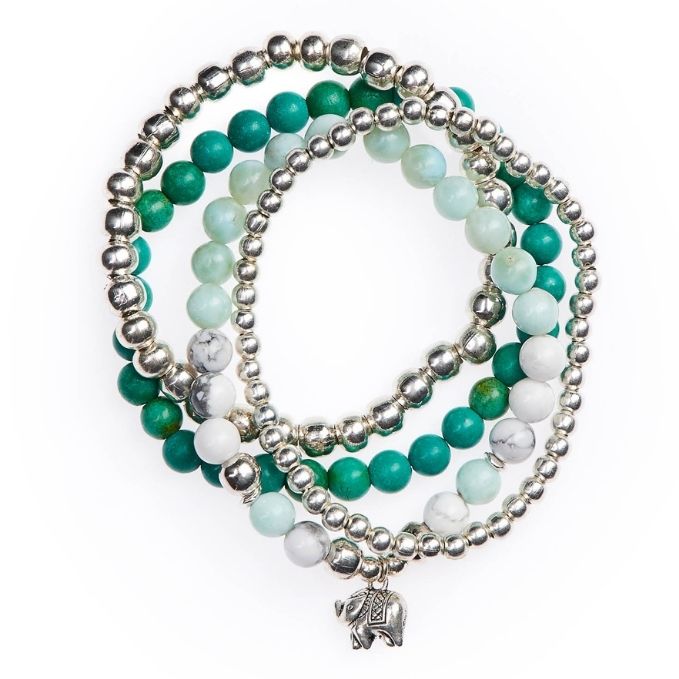
Akitai's amazonite and howlite charm bracelet is the one that names it. Since Akitai is the brand behind this site, it is our own product. The product photo shows a stack of stretch bracelets with green, pale blue-green and white beads, silver-colored beads and one small elephant charm. Howlite is a white mineral that is much softer, at 3.5, according to the Handbook of Mineralogy. Browse the charm bracelet collection, or read Akitai's guide to charm bracelet symbols.
No. Its associations are traditional beliefs, and a stone is not a treatment for any condition. Geology.com calls the healing claims anecdotal.
Green to bluish green, and rarely greenish blue. It is often streaked with white quartz or feldspar.
Yes. It is softer than quartz and has two directions of perfect cleavage, so a hard knock can chip or break it.
No. "Amazon jade" is a misnomer some vendors used, according to Geology.com. Amazonite is a feldspar.
From the Amazon River, though there are no known amazonite occurrences near it.
The non-commercial sources checked give it none. Geology.com's list of commonly used chakra stones does not include amazonite, and no authority sets chakra matches.
Geology.com says amazonite has been used as a gem for over 2,000 years, and Wikipedia says archaeological finds in Egypt and Mesopotamia show use for more than three thousand years.
Available Now
Browse the full collection — free Prime shipping on eligible orders. Every purchase directly supports our artisan community.
Shop on Amazon