
Quick Answer: A crystal prism sun catcher makes rainbows by bending sunlight. White light is a mix of colors, and each color bends by a slightly different amount as it passes through clear, angled crystal or glass, so the colors spread apart into a spectrum. It needs direct sun to work. Crystal and glass in direct sun can also start a fire if they sit near anything flammable.
A sun catcher that throws rainbows is doing a simple piece of physics that Isaac Newton worked out in the 1600s. This post explains how a crystal prism splits sunlight, how that differs from a rainbow in the sky, what to look for in a piece, and which of Akitai's sun catchers use crystal beads. For a general introduction, start with what a sun catcher is and how it works.
Each color of light bends by a different amount, so a prism pulls them apart. NASA (checked October 2026) says that as the full spectrum of visible light travels through a prism, the wavelengths separate into the colors of the rainbow because each color is a different wavelength. Newton's experiment in 1665 showed that a prism bends visible light and that each color refracts at a slightly different angle.
The Physics Classroom calls this separation dispersion. It says violet light bends a bit more than red, because glass slows violet more. NASA says the human eye can detect wavelengths from 380 to 700 nanometers, so the table puts the two ends of what we see side by side.
| End of the spectrum | Wavelength (NASA) | Refractive index, some glass |
|---|---|---|
| Violet | About 380 nm | 1.53 |
| Red | About 700 nm | 1.51 |
A higher index means a bit more bending. That small gap is enough to spread white light into a band of colors.
Not quite. The Met Office says a rainbow is created by refraction and reflection of sunlight in water droplets. Light enters a raindrop, bends, reflects off the inside surface, exits and bends again, so the sun must be behind you with droplets in front.
A glass or crystal piece has no water droplets, so there is no reflection off the inside of a drop. It separates color mainly by refraction, as a prism does, and throws the colors onto a wall or floor. Both effects start with the same fact, that different colors bend by different amounts.
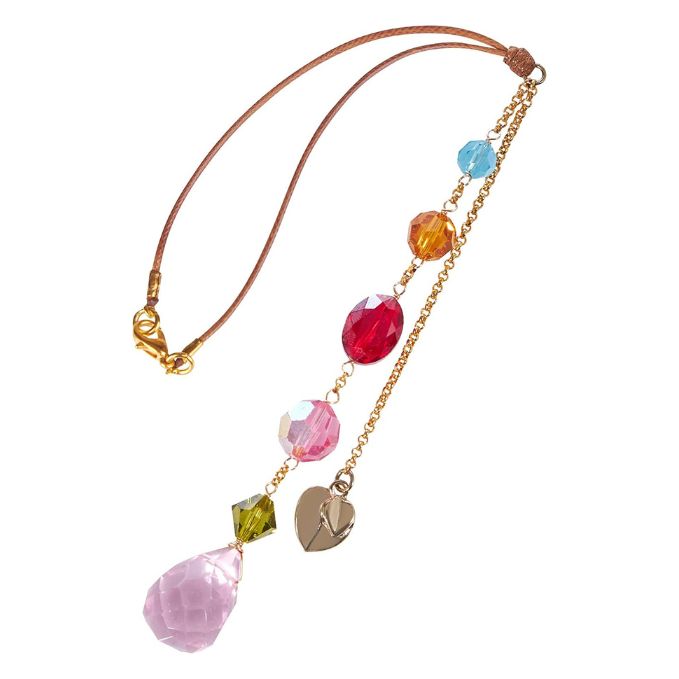
Look for clear pieces with flat, angled faces, because those are what bend the light. This is a practical reading of the physics above rather than a tested rating, and no source ranks sun catchers. In Akitai's product photos, the pink crystals sun catcher shows faceted beads in several colors and a large faceted pink drop, and the white crystals cross shows clear faceted beads along a chain. The product pages call the beads crystal.
Direct sunlight. Without sun, nothing is there to split, so the effect comes and goes with the weather and the time of day. A window where the sun falls is the usual place.
There is a caution. Snopes (checked October 2026) reports a Delton, Wisconsin house fire on 8 March 2021 that the fire department traced to a glass "crystal ball" ornament in direct sun. The department advised keeping crystals, mirrors, glass ornaments and bottles out of direct sunlight and away from anything flammable.
Akitai's pink crystals sun catcher and white crystals cross are two examples. Since Akitai is the brand behind this site, they are our own products. Both list beads, crystal and brass on a polyester rope, and the cross is a cross-shaped pendant, which many people read as a Christian symbol. See the whole sun catcher collection.
A clear, faceted crystal or glass piece can, in direct sun. It bends sunlight and spreads it into colors, as a prism does.
It is a sun catcher that throws spectrum colors onto nearby surfaces, usually a faceted crystal or glass piece hung in sun.
Because each color of light bends by a slightly different amount as it passes through, so the colors separate.
Yes. The colors come from sunlight, so direct sun gives the clearest result.
In direct sun, near something flammable, yes. Fire officials advise keeping crystals and glass ornaments away from direct sunlight and flammable things.
Not exactly. A prism is an optical tool with a set shape, and a faceted sun catcher uses the same principle but is made to be decorative.
It is a spectrum made by refraction, as a rainbow is, but a sky rainbow also involves reflection inside water droplets.
Available Now
Browse the full collection — free Prime shipping on eligible orders. Every purchase directly supports our artisan community.
Shop on Amazon