
Quick Answer: A lucky charm is an object believed to bring good luck, and what it stands for depends on the culture it comes from. The four-leaf clover is tied to Irish and other European luck traditions, the horseshoe is read as lucky in several European cultures, and the elephant is Thailand's national animal. These are traditional beliefs, not promises, so treat a charm as a keepsake with a story.
Charm bracelets carry small symbols, and some of them are chosen because a tradition links them with luck. This guide covers the charms most often read as lucky, what each is traditionally said to stand for, and the one charm on Akitai's own bracelets. For symbols beyond luck, such as loved ones, hobbies and milestones, see Akitai's guide to charm bracelet symbols. For what bead colors are said to mean, see the color-by-color guide.
A charm counts as lucky because a tradition says so, not because of the object itself. Wikipedia's list of lucky symbols (checked September 2026) says almost any object can be used as a charm, and that each symbol's significance is rooted in folklore, mythology, religion or tradition, and varies between cultures. The same shape can carry a different meaning in two places.
That is worth knowing before you buy. Ask which tradition a charm belongs to, and whether that tradition is one the wearer would recognize.
The charms below are read as lucky in the traditions named. The charms and traditions come from the Wikipedia list above, and the elephant reading comes from WorldAtlas, covered next.
| Charm | Tradition | Read as |
|---|---|---|
| Elephant (white) | Thai, Burmese | Royal power, prosperity |
| Four-leaf clover | Irish, German, Polish | Good luck |
| Horseshoe | English, Polish, Indian | Good luck |
| Ladybird | German, Italian, Polish | Good luck |
| Wishbone | European, North American | Good luck |
| Acorn | Norse | Good luck |
Even within one symbol, people disagree. Wikipedia's horseshoe entry says that in parts of Ireland and Britain a horseshoe is hung with the ends up, to catch luck, while French, German, Italian and Spanish influences favor the ends down.
The clover shows how a local story shapes a symbol. The Wikipedia list says followers of St. Patrick adopted the four-leaf clover as a symbol of Irish luck because clovers are common in the hills of Ireland. It adds that in Ireland every shamrock is read as lucky, while in most of the world only the four-leaf clover is.
In Thailand the elephant is a national symbol. Wikipedia lists the Thai elephant as the official national animal. A rare pale "white elephant" has a further royal meaning: WorldAtlas (checked September 2026) says white elephants presented to the king are read as signs of a righteous, blessed reign.
On Akitai's site, three of the four charm bracelets show one small, silver-colored elephant charm in the product photo: the amazonite and howlite bracelet, the aventurine bracelet and the jasper and chrysocolla bracelet. Since Akitai is the brand behind this site, they are our own products. Akitai's product pages say the bracelets are handmade in Thailand, but they do not say what the elephant is meant to stand for. What is written above is how the animal is read in Thai tradition, not a claim about these bracelets. See the full charm bracelet collection.
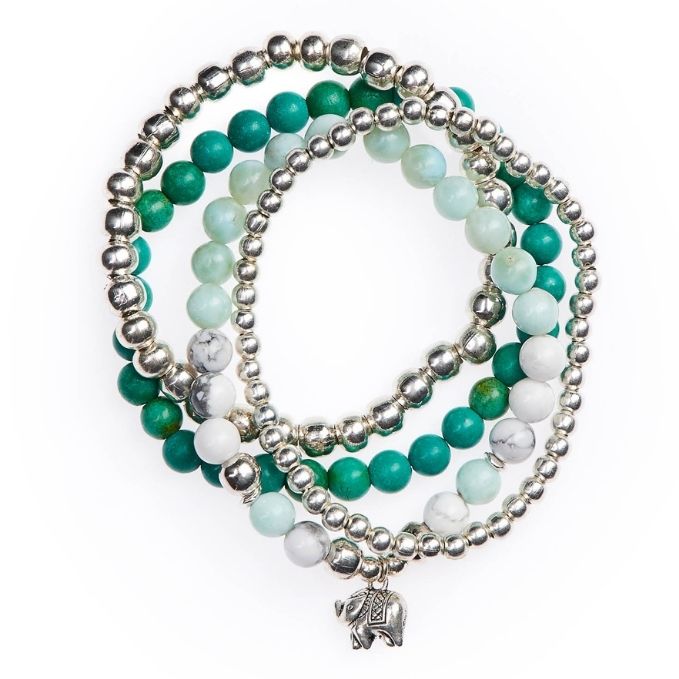
Choose from a tradition you recognize, or from a story of your own. A charm from a trip, a gift from a friend or an animal you like carries more for its wearer than any list can. If you are buying for someone else, check that the tradition behind the charm is one they would welcome. A stone name can carry a luck story too. Wikipedia says the name aventurine comes from the Italian for "by chance", an allusion to the lucky discovery of aventurine glass in the 18th century. To see how charms and bracelets fit together on a wrist, read Akitai's post on stacking charm bracelets.
It depends on the tradition. In Thailand the elephant is the national animal, and the white elephant is a royal symbol of a blessed reign.
Common ones include the four-leaf clover, horseshoe, ladybird, wishbone, acorn and, in Thai and Burmese tradition, the white elephant.
Traditionally, yes. Wikipedia says tradition holds that such clovers bring good luck, a belief that dates back to at least the 17th century.
There is no single rule. Some traditions point the ends up to catch luck, and others point them down.
Nothing in this guide says they do. Lucky charms are traditional symbols, and people wear them for meaning, memory or fun.
It means whatever its charms stand for in the tradition the wearer follows. There is no one official meaning.
Available Now
Browse the full collection — free Prime shipping on eligible orders. Every purchase directly supports our artisan community.
Shop on Amazon